Showing posts with label arteries. Show all posts

Friday, October 9, 2015

Signs and Symptoms of Atherosclerosis

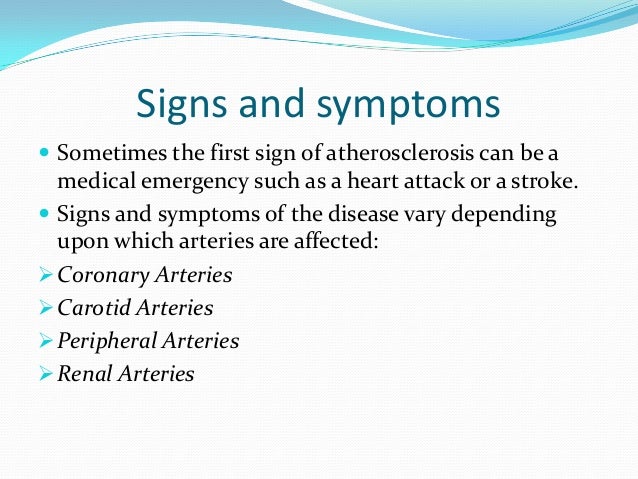
Atherosclerosis, latent in its nature, is a disease difficult to diagnose due to its general lack of overt signs and symptoms.  Because the progression of this disease occurs hidden within the lumen of the body's arteries, people do not regularly check for this disease until severe damage, such as a myocardial infarction or stroke occurs.  As a result, many people do not realize they have atherosclerosis until such medical emergencies take place.

However, while this disease has a relatively small number of signs to look for, there are a few key identifiers, that might indicate the presence of atherosclerosis. Yet, it is important to remember that each sign and symptom is different according to the affected artery. One symptom that many people experience in relation to coronary arteries is angina.  Angina is a pain or discomfort that takes place in the chest when the heart is not receiving an adequate amount of blood.  Someone experiencing this symptom may feel a tight pressure in the pleural cavity.  This pressure can also extend through one's shoulders, arms, neck, jaw or back, and can be triggered by emotional stress and physical activity, or relieved with rest.  Additional symptoms of coronary heart disease (CHD) include shortness of breath and arrhythmia.
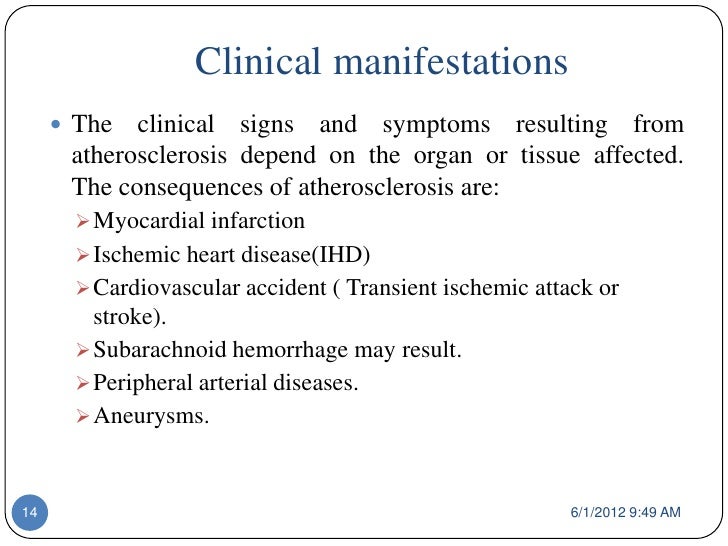
Another primary location for atherosclerosis is the carotid arteries.  Blockage of these arteries prevents the flow of oxygen-rich blood to the brain and can cause a stroke. Symptoms and signs of carotid artery disease include sudden weakness, paralysis or numbness in one half of the body, confusion, trouble speaking and understanding, dizziness, loss of balance and coordination, as well as difficulty breathing.

Finally, plaque buildup can occur in the peripheral and renal arteries.  Peripheral arteries are the arteries leading to legs, arms and pelvis. Numbness and pain are the primary symptoms of peripheral arterial disease, and while blockage of these arteries is not as severe, understanding the symptoms is important nonetheless.  Blockage to the renal arteries can result in chronic kidney disease which can lead to decreased kidney function.  Initially, there is no way to determine whether or not someone has chronic kidney disease.  However, with time people see changes in their urination patterns, loss of appetite, nausea and swelling in the hands or feet.

http://www.mayoclinic.org/diseases-conditions/arteriosclerosis-atherosclerosis/basics/symptoms/con-20026972


Thursday, October 1, 2015

Diagnosis of Atherosclerosis

Atherosclerosis is a silent disease that progresses slowly, not fully showing signs until about the 5th decade of life.  Over time as the plaque builds, its potential for harm gradually increases and reaches its full potential when a thrombus is formed or the lumen of an artery is completely blocked. Yet, regardless of its tendency to progress slowly, given its numerous risk factors, it is important to stay up to date and be assessed frequently for any signs indicating atherosclerosis.  
Typically, a diagnosis is formed based on medical and family history, physical exams and test results. After having visited a primary care doctor, specialists such as cardiologists, vascular specialists or neurologists might be recommended in order to diagnose specific issues that may be associated with atherosclerosis.  
During a general physical exam, the doctor will listen to the arteries to determine abnormal sounds. In this case, they are listening for a sound called bruit.  This sound indicates inadequate blood flow which could be a result of plaque buildup.  The presence of a blocked artery can also be determined via the pulse.  A weak pulse, such as in the leg or foot, is a possible indication that there is a blocked artery.  Atherosclerosis can also be determined through specific diagnostic tests.  Such tests include blood tests, an electrocardiogram (EKG), chest X Rays, the ankle/brachial index, computed tomography scans, stress testing and angiography.  Many of these tests either allow a clearer view of plaque buildup within arteries, or assess the heart for abnormal blood flow.  Below is a short summary describing how each of the above tests are used in diagnosing atherosclerosis.  
Blood tests: blood test can show levels of fats, cholesterol, sugar and protein. Abnormal results may indicate a possibility for atherosclerosis.
EKG: EKG’s can monitor and record the heart’s electrical activity and whether its rate and rhythm are normal or irregular. This type of test can show signs of heart damage that result from cardiovascular heart disease or signs of a previous or current heart attack.
Chest X Ray: similar to the EKG, the chest X Ray can show signs of heart failure by taking pictures of the organs inside the chest (ie: heart, lungs, blood vessels)
Ankle/brachial index: the ankle/brachial index compares the blood pressures of the posterior tibial artery and the brachial artery to determine the adequacy of blood flow in contiguous areas.
Computed tomography scan: this test creates pictures of the heart, brain or other parts of the body to illustrate hardening and/or narrowing of more prominent arteries.
Stress testing: in stress testing, through exercise or medication, the heart is made to work harder.  As it does so, it requires more oxygen and blood. Pictures of the heart are taken during and after exercise. When there is a presence of plaque in the arteries, certain parts of the heart don’t receive the blood flow it requires, which is shown in the pictures.
Angiography: an angiography is a test that uses dye and X rays to help view the inside of the arteries.  This allows a clear view of how much plaque is progressively building up.


Wednesday, September 2, 2015

What is Atherosclerosis and How Does it Affect the Body?

Atherosclerosis, also known as Ateriosclerotic Vascular Disease (ASVD), is a disease that results when an excessive buildup of plaque forms and adheres to the lining of the body’s arteries.  As the plaque lingers, it begins to harden, causing these blood vessels to narrow and restrict blood flow from the heart to the body’s tissues and organs. This limited ability to receive oxygenated blood can cause serious cardiovascular complications such as strokes, myocardial infarctions and even death if not treated properly or in a timely manner.  
   
ASVD begins to form when the endothelium, a thin layer of cells lining the lumen of the artery, is damaged.  Damage to the endothelium can result from high blood pressure, smoking, or high cholesterol levels. The impaired layer allows LDL cholesterol to accumulate along the wall.  In response to this foreign buildup, the body sends white blood cells called macrophages to act as a defense system and rid the body of the cholesterol. However, what was initially meant as good can lead to bad.  Occasionally, some of the macrophages will remain in the damaged area, and as they conglomerate with the cholesterol, plaque begins to form.  The continual presence and flow of blood through the artery contributes other substances such as fat and calcium to the buildup.  While the limited flow of blood through the body is unsafe, the true danger occurs when a piece of plaque breaks away or when a thrombus forms.  If either of these blocks the artery, the flow of blood discontinues, significantly reducing the oxygen supply to the body.  Were this to occur in either of the two coronary arteries, the heart is deprived of oxygen and undergoes cardiac ischemia.  Prolonged, the tissues of the heart die and myocardial infarction occurs.  Further, the same idea is applied when the brain’s arteries are blocked, and the brain receives an insufficient supply of oxygen.  Without the essential oxygen, the brain tissue dies and a stroke ensues.   


While atherosclerosis might initially seem trivial, it has the potential to substantially affect your health. So the question is, will you let it?


For more information visit the link below:


“Atherosclerosis – 3D Animation || ABP ©.” YouTube. YouTube, n.d. Web. 04 Sept. 2015.
Rooke, Jennifer. Atherosclerosis. Digital image. Advanced Lifestyle Medicine. N.p., n.d. Web. 2 Sept. 2015.